
Please enable JavaScript to access this page.
Tampilkan postingan dengan label Info Technology. Tampilkan semua postingan

Senin, 25 April 2011

The Army's first smartphone? Android, of course


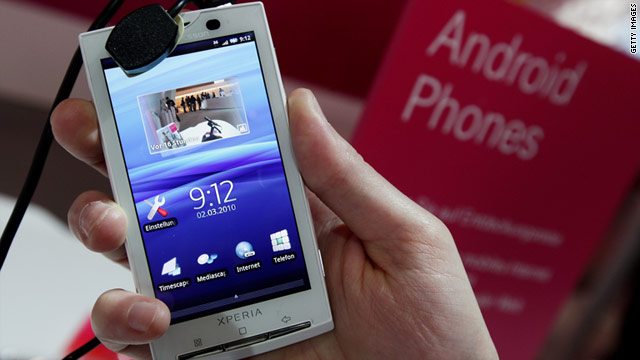
An Army phone, beefier than this Android model, could help soldiers fine-tune targeting for missiles and other munitions.

Editor's note:
Amy Gahran writes about mobile tech for CNN.com. She is a San Francisco Bay Area writer and media consultant whose blog, Contentious.com, explores how people communicate in the online age.

(CNN) -- I was recently in Fort Knox, Kentucky, to visit my nephew in Army Basic Training, where my sister gave him a basic Tracphone so he could call home more easily.

But he might soon be getting a substantial upgrade: The U.S. Army announced that it has chosen the Android operating system to power its first smartphone.

This news comes just about when (according to the timeline set forth by Sarah Connor in "The Terminator" franchise) the world-dominating, human-exterminating computer network Skynet becomes self aware.

I'm sure that's just a coincidence.

Wired's Danger Room blog reports, "A prototype device running Android called the Joint Battle Command-Platform (JBC-P Handheld), developed by tech nonprofit MITRE, is undergoing tests."

This platform will allow soldiers to quickly and (hopefully) securely share geotagged notes about obstacles they encounter on the ground. It will also support mapping, critical messaging and other support functions.

The Army announcement explained that the JBC-P Handheld is an "Android-based smartphone framework and suite of applications for tactical operations. ... Applications will be secure and interoperable with existing mission command systems so information flows seamlessly across all echelons of the force."

Third-party developers will be building apps and services for this Army smartphone. In July, the Army will release a development kit for the platform.

The Army wants applications that share data and resources across the platform, to avoid the "stovepiping" problems that have plagued so many military and government information technology projects.

Systems integration is key: It could allow soldiers on the ground to fine-tune targeting for missiles and other munitions, as well as request specific aerial drone or satellite reconnaissance. It might also borrow from supply-chain software to manage requests for equipment and supplies. And it could support or enhance field medical treatment, as well as all kinds of in-field training.

Rather than sign up for thousands of pricey two-year wireless carrier contracts, the JBC-P Handhelds will communicate over several existing military radio networks.

When connected to the radio, the prototype device weighs about 2 pounds. That's considerably heavier than the current heftiest smartphone, the HTC ThunderBolt (6.23 ounces). Still, Wired notes that it's "way lighter than the Nett Warrior suite of sensors, computers, radios and mapping functions -- the Army's program of record for doing much of what a smartphone already does."

Battery technology and power management have been big problems for commercial smartphones. Bright displays (often necessary in full daylight) and GPS are notorious energy vampires that leave many smartphone owners hunting for outlets on a daily basis.

In the field, military smartphones would require far more power than commercial models, and they'd have to operate for much longer periods. It'll be interesting to see what battery and charging options (including possibly solar and hand-crank) are supplied with these new Army phones.

Also, military smartphones must be far more rugged than commercial models, able to withstand sand, dust, water, temperature extremes, impact, concussion and more. Microphones that don't get destroyed by loud blasts will be crucial, as will noise filtering for incoming and outgoing audio (something most commercial smartphones generally do poorly).

The Army did not specify whether the phones will come with unlimited text messaging. I hope a remote wipe service comes standard.

The opinions expressed in this post are solely those of Amy Gahran.

Tech Check: Your iPhone is watching you


t1larg.tech.check.cnn.jpg

Editor's note: In our Tech Check podcast, CNN.com's tech team makes sense of -- and sometimes makes light off -- the week's technology news.

(CNN) -- iPhones are tracking you.

Digital library books are coming to the Kindle.

And Facebook was "accidentally" junking up your e-mail inbox.

In this episode of our Tech Check podcast, the CNN.com tech team -- including Doug Gross, John D. Sutter and Stephanie Goldberg -- breaks down these topics and more of the week's technology news.

You can listen to the show on this page, or hit us up on the RSS feed -- or subscribe to the podcast though iTunes.

As always, let us know what you think by commenting on this page or by sending us a note on Twitter (We're @cnntech).

You never know -- your thoughts could end up as our "reader comment of the week" in the next episode.

Gamers frustrated as Sony PlayStation outage continues

By John D. Sutter, CNN

Sony said Thursday that its PlayStation network may be down for a day or two.

(CNN)
-- Sony's PlayStation network continued to be down on Friday morning.

The company on Thursday posted a statement on its blog saying the outage, which prevents users of that gaming system from accessing online features, may continue for "a full day or two."

PlayStation users expressed frustration about the crash.

"Dear @playstation, I'ma need for y'all 2 fix this 'not signing' into the playstation network bs asap," one Twitter user wrote.

It's unclear what caused the network to fail, and Sony did not immediately respond to a CNN request for comment.

There are unconfirmed reports, however, that Sony may be the victim of a cyber attack. According to a gaming site, Sony had posted on one of its European blogs that the outage may have been the result of an attack.

It appears that post has since been taken down or edited.

GameSpy.com quotes Sony as saying:

"Our support teams are investigating the cause of the problem, including the possibility of targeted behavior by an outside party. If the reported Network problems are indeed caused by such acts, we would like to once again thank our customers who have borne the brunt of the attack through interrupted service."

The Christian Science Monitor says Sony was the victim of cyber attacks earlier this year.

"The DDoS attacks, made famous after Anonymous' retaliation for the Wikileaks shutdown, were used again earlier this month on various Sony sites. The Low Orbit Ion Cannon (LOIC) was the sci-fi-sounding tool Anonymous used, but it did not bring the network down completely like it was brought down last night," that news site wrote on Thursday.

"Earlier this year, after Anonymous' hack, Sony engineers said the attacks were only 'medium strength' and were more of an annoyance to engineers than anything else. "

Users who tried to log on to the PlayStation network Thursday and Friday were greeted with error messages. The network allows people who own a PlayStation gaming console -- like the PS3 -- to play video games with people in remote locations. Users also can download games from the internet using the network feature.

"PlayStation Network is your all-access pass to a world of entertainment," Sony says on its website. "Get games, movies, TV series and community all in one place. PlayStation Network is full of exclusives like new games, add-ons and video and, best of all, it's free for everyone."

Sony asked PlayStation users for their patience with the crash:

"While we are investigating the cause of the Network outage, we wanted to alert you that it may be a full day or two before we're able to get the service completely back up and running," the company wrote.

"Thank you very much for your patience while we work to resolve this matter. Please stay tuned to this space for more details, and we'll update you again as soon as we can."

Learning from Amazon's cloud collapse


Amazon may be best-known for its online shopping site, but it also has a substantial cloud computing business.

(Mashable)
-- Call it Cloudgate, Cloudpocalyse or whatever you'd like, but the extended collapse of Amazon Elastic Cloud Compute (EC2) is both a setback for cloud computing and an opportunity for us to figure out how to stop it from happening again.

Amazon may be best-known for its online shopping site, but it also has a substantial cloud computing business. It provides a scalable, flexible and particularly efficient solution for companies to store and deliver massive amounts of content.

Its model of only paying for what you consume was a radical innovation when it launched in 2006.

In fact, Amazon Web Services has been so affordable and reliable that thousands of companies from Foursquare to Netflix utilize the company's cloud computing technology and servers to run their businesses.

They put their faith in Amazon's cloud because there was no reason to think that it would falter. One of cloud computing's key tenants is reliability through redundancy of both servers and data centers.

Then on Wednesday, Amazon's northern Virginia data center started experiencing problems that caused major latency and connectivity issues.

The trouble was apparently due to excessive re-mirroring of its Elastic Block Storage (EBS) volumes -- this essentially created countless new backups of the EBS volumes that took up Amazon's storage capacity and triggered a cascading effect that caused downtime on hundreds (or more likely thousands) of websites for almost 24 hours.

The collapse took its share of victims. Among the most prominent companies affected were Foursquare, Quora, Hootsuite, SCVNGR, Heroku, Reddit and Wildfire, though hundreds of other companies big and small were affected.

Luckily, one of Amazon's most prominent customers, Netflix, didn't experience problems because it's built for the loss of an entire data center, while companies relying on Amazon's four other global data centers didn't experience too many issues.

A learning moment

FathomDB founder Justin Santa Barbara has a detailed post on his blog about what may be the biggest problem to come out of this week's collapse: Amazon's cloud redundancies failed to stop a mass outage.

Its Availability Zones are supposed to be able to fail independently without bringing the whole system down. Instead, there was a single point of failure that shouldn't have been there.

This week's disaster in the cloud is a reminder to startups to build redundancy into their applications and their own systems, but as Santa Barbara points out, most startups don't have the time or resources to engineer for multiple cloud systems (each Amazon global region/data center has its own rules and features, making a simple "switch" to another center difficult).

These companies trusted Amazon to keep them online, and Amazon failed to deliver.

Catastrophic issues will always occur, but in the pre-cloud era, downtime only affected a single computer or website. Today, a catastrophic event takes down thousands of websites, causing millions or even billions of dollars in lost revenue and productivity.

This incident is no reason for us to shun cloud computing, though. Its benefits (scalability, cost reduction, device independence, performance and more) far outweigh its cons.

We do need to take a hard look at how we structure our cloud infrastructure though and find new ways to either prevent single points of failure or quickly move content off failing clouds faster, especially as the world's computing power is consolidated into fewer and fewer systems.

Cloud computing is still in its infancy, and today's events make it clear that we still have a lot of work to do. It could be a whole lot worse next time if we aren't prepared.

See the original article at Mashable.com.

© 2010 MASHABLE.com. All rights reserved.

 
Design by Bluebird-Indonesia | Created by Blog Division of Angelheart.co