
Please enable JavaScript to access this page.
Tampilkan postingan dengan label Economy. Tampilkan semua postingan

Senin, 25 April 2011

China broadens stress tests for banks

By Jamil Anderlini, FT.com

t1larg.jpg

(FT) -- China has ordered its banks to conduct stress tests to see how they would be affected if property prices fell by up to 50 per cent, in a sign of growing official unease about the overheated real estate market.

The tests are more stringent and factor in a larger drop in prices than earlier ones conducted in the past two years. This comes after predictions from prominent Chinese analysts of 20-30 per cent property price declines this year.

Analysts said previous tests looked only at the effect of housing price declines on loans to developers and mortgage borrowers, and disregarded the effect on loans collateralised by land and real estate. This resulted in an overly optimistic assessment of their exposure to a serious property market correction.

"If property prices drop 50 per cent we would be in big trouble; it would mean a hard landing for the economy," according to Wang Tao, chief China economist at UBS Securities. UBS recently described the Chinese property market as the single most important sector in the entire global economy because of the overwhelming importance of real estate construction to China's growth model and, by extension, global commodity demand.

Ms Wang said a crash in the real estate market could have a huge effect on developers, cement companies, steel producers and consumer purchases of items such as cars and appliances, which are closely correlated to property sales.

For now, prices are still rising in China despite more than a year of government policies to cool the sector and bring down prices that are well out of reach of most of the population.

Property transaction volume across the whole country increased in the first quarter of the year from the same period a year earlier but a closer look at data shows a steep decline in March in the 10 largest cities, which often lead the rest of the country.

Transaction volume collapsed 40 per cent from a year earlier in China's 10 largest cities in March following a 33 per cent increase in the first two months, according to Du Jinsong, a real estate analyst at Credit Suisse.

Mr Du forecasts a 5-10 per cent decline in real estate prices in China this year, accompanied by a 15 per cent dfal in transaction volume but he said most Chinese analysts were predicting a 20-30 per cent decline in prices this year.

Officials say about 20 per cent of all Chinese bank lending has gone directly to mortgage borrowers or property developers but a huge proportion of loans to other borrowers are backed by land as collateral.

China's banking regulator said it had asked banks to test the effect of 50 per cent price drops in cities with the fastest price increases, but in cities where prices had not risen as much banks were required to test for price drops of 40 per cent, 30 per cent or less.

Officials were quick to point out the stress tests were not a prediction by the regulator or an indication of the government's expectations.

Beijing has introduced a series of measures since last year to slow soaring prices, including raising interest rates, raising down-payment requirements, directly restricting home purchases, imposing price control targets and levying a trial real estate tax in Shanghai and Chongqing, two of China's biggest cities.
Norio Ohga, former Sony president and chairman, dies

By the CNN Wire Staff

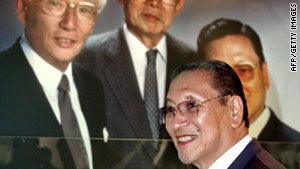
A 2002 file photo of Norio Ohga.

Tokyo (CNN) -- Norio Ohga, the former president and chairman of Sony Corporation who helped to develop the compact disc, died Saturday of multiple organ failure, the company said. He was 81.

Ohga worked for what is now Sony as a consultant and adviser while still a music student in Tokyo, before joining the company full time in 1959.

He rose to the ranks of chairman and president and is credited with driving the company's growth in movies, video games and music.

Ohga saw the potential of the compact disc early and spearheaded Sony's efforts in that area, the company said.

His training as a musician led him to push for a 12-centimeter format, providing enough storage to allow listeners to hear all of Ludwig van Beethoven's Ninth Symphony without interruption, according to Sony. Those specifications are still in use today.

The company sold the world's first CD in 1982 and within five years, CD sales overtook LP record sales in Japan.

Ohga is also credited with launching Sony's game business and was head of Sony when it bought Columbia Pictures in 1989.

He was a senior adviser to Sony at the time of his death.

"By redefining Sony as a company encompassing both hardware and software, Ohga-san succeeded where other Japanese companies failed. It is no exaggeration to attribute Sony's evolution beyond audio and video products into music, movies and games, and subsequent transformation into a global entertainment leader to Ohga-san's foresight and vision," Sony Chief Executive Howard Stringer said in a statement.

"I offer my deepest condolences on his passing and pray that he may rest in peace."

Glencore reveals bet on grain price rise

By Javier Blas and Jack Farchy

Swiss commodities giant Glencore's headquarters in Baar

London (FT.com) -- Glencore made a speculative bet on rising wheat and corn prices in the early stages of last summer's Russian drought, the world's largest commodity trader has revealed ahead of its initial public offering that will value the company at $60bn.

As it bet on rising prices, senior traders at the Swiss-based company publicly urged Russia to impose a grain export ban. Moscow acted a few days later, triggering a grain rally. Glencore is the largest trader in Russian wheat, followed by US-based rivals Cargill and Bunge.

The issue is sensitive because politicians such as Nicolas Sarkozy, the French president, have often blamed speculators for rising food prices. The G-20 group of leading economies will hold a special meeting in June to discuss grain markets.

Glencore revealed the proprietary trades to UBS, one of the banks underwriting its flotation, in a rare disclosure for a company that guards its market insights closely.

"[Glencore's] agricultural team received very timely reports from Russia farm assets that growing conditions were deteriorating aggressively in the spring and summer of 2010, as the Russian drought set in," UBS said in a pre-IPO report circulated to potential investors and seen by the Financial Times. "This put it in a position to make proprietary trades going long wheat and corn."

On August 3, Yury Ognev, head of Glencore's Russian grain unit, encouraged Moscow to ban wheat exports, saying: "From our point of view the government has all the reasons to stop all exports." His deputy made similar comments. At the time Glencore distanced itself from the comments, saying they represented Mr Ognev's personal views. Russia imposed the ban on August 5, sending the price of the cereal more than 15 per cent higher in two days.

Glencore said on Sunday its overall positions in grains had mixed "outcomes" in 2010. The export ban trapped Russian wheat the trading house had bought in advance to supply a Middle Eastern country. "So we had to buy more expensive wheat from elsewhere to meet that obligation," it said. "The export ban did not particularly help our business."

Glencore agreed to supply wheat to its customer, believed to be Egypt, with a contract that did not stipulate the source of the wheat, something known in the industry as "optional origin" agreement. The flexible contract prevented the company from declaring force majeure, in effect a common legal clause that allows traders to walk away from supply contracts for causes beyond their control, such as an export ban.

Earnings before interest and tax at Glencore's agricultural division more than doubled to $659m last year, according to figures provided to analysts. Other top trading houses, including Cargill, benefited from the supply disruption in Russian wheat, but some, such as Archer Daniels Midland, suffered.

Glencore has stressed it rarely makes proprietary trades on the direction of commodity prices. It said profits from such activities account for a "substantial minority" of the profitability of its trading business. However, the company has not provided details of the split of earnings between its day-to-day arbitrage trading activities and its more rare speculative, or proprietary, trading positions, analysts said.

Liberum Capital, which is part of Glencore's IPO banking syndicate, estimated that proprietary positions probably account for single-digit percentage of the company's overall profits in trading. But Olivia Ker, lead analyst on the UBS report, wrote that without further disclosure, "valuing the profit stream from Glencore's proprietary trading will be an act of faith by investors."

Analysts at the nine banks involved in the IPO have put an average valuation of $62bn on Glencore, with a third of that coming from the trading business. The flotation, expected to raise up to $12bn in late May, would be the largest in London and the third-largest in Europe.

Glencore has said it expected to become only the third company -- and the first in 25 years -- to enter the blue-chip FTSE 100 index on its first day of trading.

 
Design by Bluebird-Indonesia | Created by Blog Division of Angelheart.co