Please enable JavaScript to access this page.
Tampilkan postingan dengan label Global. Tampilkan semua postingan

Senin, 25 April 2011

China broadens stress tests for banks

By Jamil Anderlini, FT.com

t1larg.jpg

(FT) -- China has ordered its banks to conduct stress tests to see how they would be affected if property prices fell by up to 50 per cent, in a sign of growing official unease about the overheated real estate market.

The tests are more stringent and factor in a larger drop in prices than earlier ones conducted in the past two years. This comes after predictions from prominent Chinese analysts of 20-30 per cent property price declines this year.

Analysts said previous tests looked only at the effect of housing price declines on loans to developers and mortgage borrowers, and disregarded the effect on loans collateralised by land and real estate. This resulted in an overly optimistic assessment of their exposure to a serious property market correction.

"If property prices drop 50 per cent we would be in big trouble; it would mean a hard landing for the economy," according to Wang Tao, chief China economist at UBS Securities. UBS recently described the Chinese property market as the single most important sector in the entire global economy because of the overwhelming importance of real estate construction to China's growth model and, by extension, global commodity demand.

Ms Wang said a crash in the real estate market could have a huge effect on developers, cement companies, steel producers and consumer purchases of items such as cars and appliances, which are closely correlated to property sales.

For now, prices are still rising in China despite more than a year of government policies to cool the sector and bring down prices that are well out of reach of most of the population.

Property transaction volume across the whole country increased in the first quarter of the year from the same period a year earlier but a closer look at data shows a steep decline in March in the 10 largest cities, which often lead the rest of the country.

Transaction volume collapsed 40 per cent from a year earlier in China's 10 largest cities in March following a 33 per cent increase in the first two months, according to Du Jinsong, a real estate analyst at Credit Suisse.

Mr Du forecasts a 5-10 per cent decline in real estate prices in China this year, accompanied by a 15 per cent dfal in transaction volume but he said most Chinese analysts were predicting a 20-30 per cent decline in prices this year.

Officials say about 20 per cent of all Chinese bank lending has gone directly to mortgage borrowers or property developers but a huge proportion of loans to other borrowers are backed by land as collateral.

China's banking regulator said it had asked banks to test the effect of 50 per cent price drops in cities with the fastest price increases, but in cities where prices had not risen as much banks were required to test for price drops of 40 per cent, 30 per cent or less.

Officials were quick to point out the stress tests were not a prediction by the regulator or an indication of the government's expectations.

Beijing has introduced a series of measures since last year to slow soaring prices, including raising interest rates, raising down-payment requirements, directly restricting home purchases, imposing price control targets and levying a trial real estate tax in Shanghai and Chongqing, two of China's biggest cities.

The town that wants nuclear waste

By Per Nyberg, CNN

Click to play
Final repository for nuclear waste

(CNN) -- Like the energy source itself, it's the question that won't go away: what can be done with spent nuclear fuel?

Sweden believes it has the answer.

The plan is to bury the country's expected 12,000 tons of nuclear waste in corrosion-resistant copper canisters under 500 meters of crystalline bedrock. There it will remain isolated from human contact for at least 100,000 years.

The idea, which still needs final approval, was developed by Swedish Nuclear Fuel and Waste Management company (SKB) -- a collective of Sweden's nuclear power companies.

After three decades of research, SKB believes that Osthammar in central Sweden is the perfect final resting place for the country's nuclear waste. Not only is the 1.9 billion year old bedrock ideal says SKB, but the locals are largely in favor of the plan and it is close to the nuclear power plant at Forsmark.


Gallery: Sweden's nuclear waste solution

I think the closer you live the less scared you are. The waste has to be stored somewhere, so why not here?
--Erik Waernulf, Osthammar resident

I grew up not far from the Forsmark nuclear power plant. In school they took us on tours of the facility and many friends' parents worked at the plant. The region also has a long history of mining and ironworks, so having the nuclear industry as neighbor was nothing strange.

My parents still live there and recently my mother got a call from a researcher asking her what she thought of the planned repository.

"Do you trust the authorities to solve the problem today in your neighborhood, or do you want to wait for a better technology and leave the waste to future generations who did not actually benefit from the nuclear power?" she was asked.

The latest poll showed that 88% of Osthammar residents are in favor of having the storage site in their community.

Swedes have a complicated relationship to nuclear power. Following the Three Mile Island incident in the U.S. in 1979, Sweden voted to shut down all its nuclear reactors by 2010.

However the decision was overturned by a new government and only two reactors were decommissioned. Today Sweden's 10 nuclear reactors produce almost half of the country's electricity.

Nearly 90% of Osthammar residents are in favour of having the nuclear storage site.

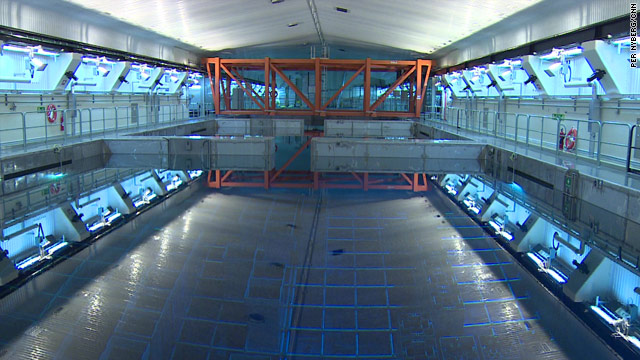
Sweden has so far accumulated more than 5,000 tons of spent fuel. It is stored in a bright blue water tank, 40 meters underground in the southern city of Oskarshamn. But even though the radiation is shielded by eight meters of water, this facility has to be monitored 24 hours a day, every day of the year.

"And we will certainly not do that for the next 100.000 years," Brita Freudenthal, SKB's guide at the facility told me.

After a few mishaps in the early stages of looking for a community that would be willing to accept the final repository, SKB started visiting the locals in their homes to have a face-to-face dialogue over some coffee and biscuits.

"The women talk more about the water, if they can eat the berries in the forest, if they can eat the moose they hunt. Men are more interested in the technology, if the canister will be safe. If there is a question, I've heard it," said Saida Laârouchi Engstrom from SKB.

Erik and Catharina Waernulf live in Forsmark with their four young children.

"SKB are very good at giving information" Catharina said.

"I think the closer you live the less scared you are. The waste has to be stored somewhere, so why not here?" Erik added.

For the mayor of Osthammar, Jacob Spangenberg, whether or not to accept the repository has nothing to do with the new investment and the new jobs it would generate.

"This is a possibility for our nation and our society to solve a very, very difficult problem," he said.

The industry's application is now undergoing a thorough review by the Swedish authorities. Mayor Spangenberg has the ultimate right of veto if he is not satisfied with the results.

There was another community, Oskarshamn, that also wanted the repository, but SKB's geological surveys showed that the bedrock was much safer near Forsmark.

But if the application doesn't go through, or Osthammar doesn't accept the results of the review, what is Sweden going to do with the waste? It's a tricky question that not only for this Nordic country has to face.

Norio Ohga, former Sony president and chairman, dies

By the CNN Wire Staff

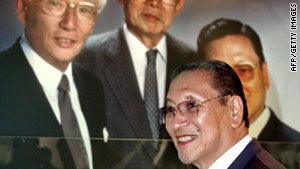
A 2002 file photo of Norio Ohga.

Tokyo (CNN) -- Norio Ohga, the former president and chairman of Sony Corporation who helped to develop the compact disc, died Saturday of multiple organ failure, the company said. He was 81.

Ohga worked for what is now Sony as a consultant and adviser while still a music student in Tokyo, before joining the company full time in 1959.

He rose to the ranks of chairman and president and is credited with driving the company's growth in movies, video games and music.

Ohga saw the potential of the compact disc early and spearheaded Sony's efforts in that area, the company said.

His training as a musician led him to push for a 12-centimeter format, providing enough storage to allow listeners to hear all of Ludwig van Beethoven's Ninth Symphony without interruption, according to Sony. Those specifications are still in use today.

The company sold the world's first CD in 1982 and within five years, CD sales overtook LP record sales in Japan.

Ohga is also credited with launching Sony's game business and was head of Sony when it bought Columbia Pictures in 1989.

He was a senior adviser to Sony at the time of his death.

"By redefining Sony as a company encompassing both hardware and software, Ohga-san succeeded where other Japanese companies failed. It is no exaggeration to attribute Sony's evolution beyond audio and video products into music, movies and games, and subsequent transformation into a global entertainment leader to Ohga-san's foresight and vision," Sony Chief Executive Howard Stringer said in a statement.

"I offer my deepest condolences on his passing and pray that he may rest in peace."

Pope calls for peace around the world in Easter message

By the CNN Wire Staff

Click to play
Pope urges peace on Easter

(CNN) -- Pope Benedict XVI called for peace amid ongoing conflicts in Africa and the Middle East and mentioned the plight of those in Japan during his annual Easter message Sunday.

The pope singled out Libya, saying, "may diplomacy and dialogue take the place of arms and may those who suffer as a result of the conflict be given access to humanitarian aid."

Forces loyal to Libyan leader Moammar Gadhafi have been battling rebels for control of parts of Libya ever since protests erupted in the country in February. Demonstrators first rallied against high unemployment and a delay in a government housing project, but they eventually called for an end to Gadhafi's four decades in power -- a protest that erupted into war.

The pope also urged the restoration of "peaceful coexistence" in Ivory Coast, where a long-running political stalemate led to violence that forced nearly a million people into the main city of Abidjan and left hundreds dead, according to aid groups.

The standoff only recently ended after President Alassane Ouattrara assumed power. The former president, Laurent Gbagbo, had refused to step down after he lost the election last year.

"There is an urgent need to tread the path of reconciliation and pardon in order to heal the deep wounds caused by the recent violence," the pope said in reference to the West African nation.

"In the countries of northern Africa and the Middle East, may all citizens, especially young people, work to promote the common good and to build a society where poverty is defeated and every political choice is inspired by respect for the human person," the pope said.

"May help come from all sides to those fleeing conflict and to refugees from various African countries who have been obliged to leave all that is dear to them; may people of good will open their hearts to welcome them, so that the pressing needs of so many brothers and sisters will be met with a concerted response in a spirit of solidarity; and may our words of comfort and appreciation reach all those who make such generous efforts and offer an exemplary witness in this regard."

Finally, the pope said he hoped Japan would find "consolation and hope" in the aftermath of the March earthquake, tsunami, and nuclear crisis, "along with other countries that in recent months have been tested by natural disasters which have sown pain and anguish."

Glencore reveals bet on grain price rise

By Javier Blas and Jack Farchy

Swiss commodities giant Glencore's headquarters in Baar

London (FT.com) -- Glencore made a speculative bet on rising wheat and corn prices in the early stages of last summer's Russian drought, the world's largest commodity trader has revealed ahead of its initial public offering that will value the company at $60bn.

As it bet on rising prices, senior traders at the Swiss-based company publicly urged Russia to impose a grain export ban. Moscow acted a few days later, triggering a grain rally. Glencore is the largest trader in Russian wheat, followed by US-based rivals Cargill and Bunge.

The issue is sensitive because politicians such as Nicolas Sarkozy, the French president, have often blamed speculators for rising food prices. The G-20 group of leading economies will hold a special meeting in June to discuss grain markets.

Glencore revealed the proprietary trades to UBS, one of the banks underwriting its flotation, in a rare disclosure for a company that guards its market insights closely.

"[Glencore's] agricultural team received very timely reports from Russia farm assets that growing conditions were deteriorating aggressively in the spring and summer of 2010, as the Russian drought set in," UBS said in a pre-IPO report circulated to potential investors and seen by the Financial Times. "This put it in a position to make proprietary trades going long wheat and corn."

On August 3, Yury Ognev, head of Glencore's Russian grain unit, encouraged Moscow to ban wheat exports, saying: "From our point of view the government has all the reasons to stop all exports." His deputy made similar comments. At the time Glencore distanced itself from the comments, saying they represented Mr Ognev's personal views. Russia imposed the ban on August 5, sending the price of the cereal more than 15 per cent higher in two days.

Glencore said on Sunday its overall positions in grains had mixed "outcomes" in 2010. The export ban trapped Russian wheat the trading house had bought in advance to supply a Middle Eastern country. "So we had to buy more expensive wheat from elsewhere to meet that obligation," it said. "The export ban did not particularly help our business."

Glencore agreed to supply wheat to its customer, believed to be Egypt, with a contract that did not stipulate the source of the wheat, something known in the industry as "optional origin" agreement. The flexible contract prevented the company from declaring force majeure, in effect a common legal clause that allows traders to walk away from supply contracts for causes beyond their control, such as an export ban.

Earnings before interest and tax at Glencore's agricultural division more than doubled to $659m last year, according to figures provided to analysts. Other top trading houses, including Cargill, benefited from the supply disruption in Russian wheat, but some, such as Archer Daniels Midland, suffered.

Glencore has stressed it rarely makes proprietary trades on the direction of commodity prices. It said profits from such activities account for a "substantial minority" of the profitability of its trading business. However, the company has not provided details of the split of earnings between its day-to-day arbitrage trading activities and its more rare speculative, or proprietary, trading positions, analysts said.

Liberum Capital, which is part of Glencore's IPO banking syndicate, estimated that proprietary positions probably account for single-digit percentage of the company's overall profits in trading. But Olivia Ker, lead analyst on the UBS report, wrote that without further disclosure, "valuing the profit stream from Glencore's proprietary trading will be an act of faith by investors."

Analysts at the nine banks involved in the IPO have put an average valuation of $62bn on Glencore, with a third of that coming from the trading business. The flotation, expected to raise up to $12bn in late May, would be the largest in London and the third-largest in Europe.

Glencore has said it expected to become only the third company -- and the first in 25 years -- to enter the blue-chip FTSE 100 index on its first day of trading.

 
Design by Bluebird-Indonesia | Created by Blog Division of Angelheart.co